
Thinking
From magic to utility: what survives every revolution
Right now, AI feels like magic. But history has taught us magic never lasts.
Every tech revolution follows the same pattern – electricity, the internet, mobile phones – starting as a miracle and capturing imaginations with sheer possibility. Over time it spreads, becoming more accessible and essential. Eventually, it recedes into the background, invisible and often taken for granted.
The question isn’t whether AI will reach that point, it’s who survives when it does.
What does a crowded AI market mean for companies?
We've seen this before. During the dot-com boom, the internet promised infinite possibility. Between 1998 and 2000, over 40,000 startups launched, each convinced it had found the future. Capital flowed freely, and everyone wanted a piece of what came next.
But then the bubble burst: Nasdaq plummeted 80%, and 95% of those companies vanished. Not because the internet failed – the technology was real and transformative – but because the ideas did. Venture capital can fund innovation, but it can't create meaning.
Today, we’re living through a similar moment with AI. In just five years, 70,000 startups have emerged and they are all built on the same stack, offering variations on the same promise and all racing to prove they are faster, smarter, more efficient.
When this happens, the underlying infrastructure becomes shared, lowering barriers to entry and opening the floodgates for new products. But instead of fostering diversity, what emerges often feels familiar, leaving users with no reason to choose one over another. The sameness is spreading as quickly as the magic itself.
We call it convergence, though it feels more like déjà vu. Here’s the pattern we’ve traced for decades:
Magic → Mass Adoption → Utility → Sameness.
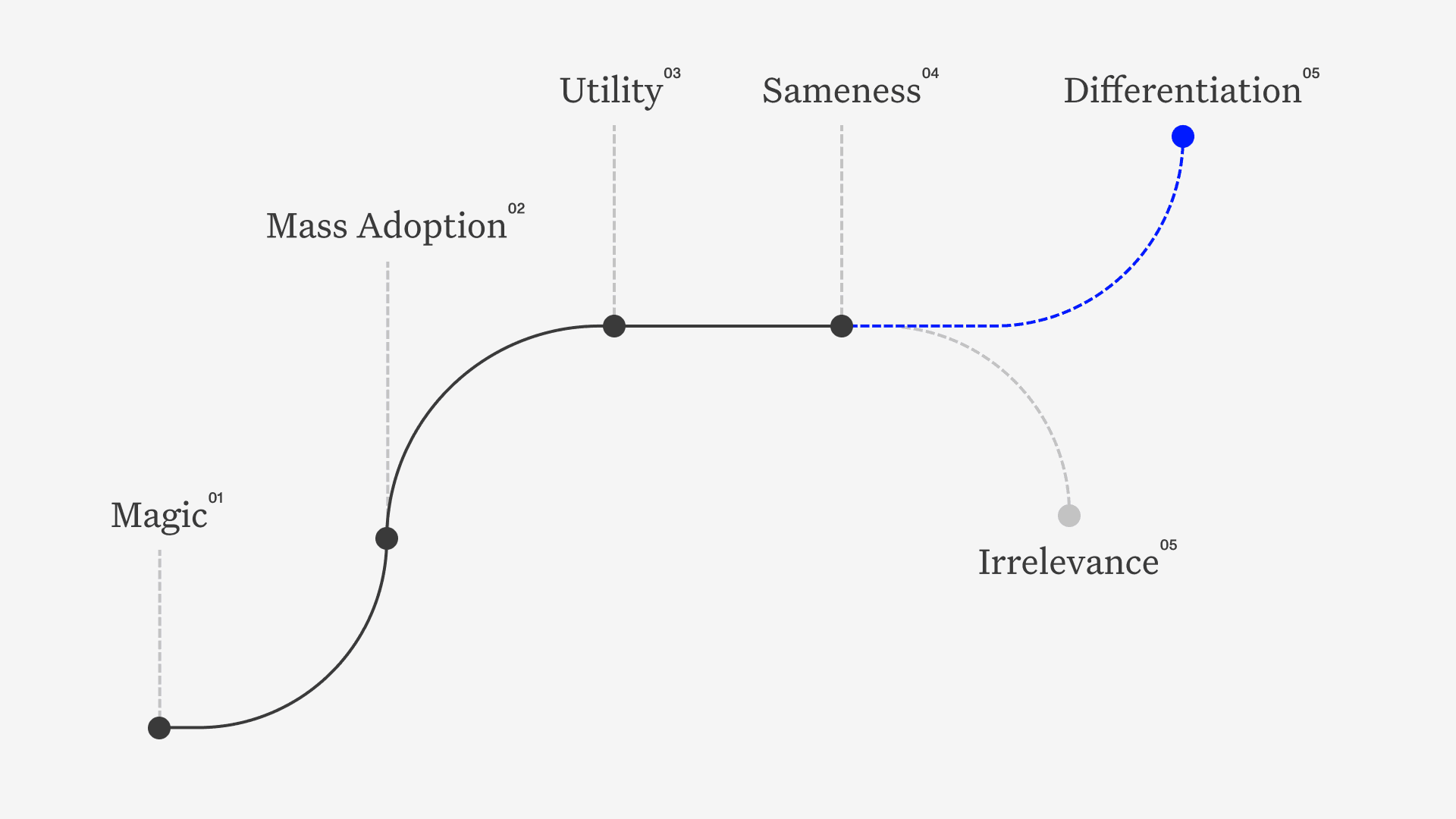
What will actually help an AI brand stand out?
History shows the answer. The companies that endured the various tech revolutions did so not because they had better technology, but because they built something meaningful.
Amazon didn’t sell products, it sold convenience. Netflix didn’t stream movies, it brought stories home. Google didn’t list the internet, it made information accessible. Technology enabled them, but they won by finding and standing for something no one else did. They built meaning on top of their tech.
This isn’t rebellion by being loud, it’s rebellion by being meaningful.
At Wolff Olins, we’ve learned across six decades that this is the answer to survival when the bubble bursts and the hype fades.

Rebellion in practice
Orange: From function to feeling
Take Orange, the UK’s fourth mobile network provider in the 90s. No new technology, no special infrastructure advantage. When Hutchison Whampoa came to us, it brought a brutal challenge: how do you get people to choose you, when everything is functionally identical?
We stepped back and looked at the broader situation. What could mobile phones mean if they weren’t just flashy gadgets for bankers and estate agents, but for everyone – a symbol of possibility rather than privilege.
We flipped the script. At that time, mobiles were a luxury, something for “them”, not “us”. So we made it a democratic tool, filled with optimism. “The future is bright. The future is Orange.”
That belief was embedded in everything – the name, the visual identity, the tone of voice, the experience. Every touchpoint told the same story: this is for you, and it changes what's possible.
And it worked with remarkable speed. Britain’s smallest network became its most loved. When France Télécom bought the business in 2000, it was worth £25 billion – more than double its closest rival. That valuation wasn't for the network infrastructure, but for the meaningful brand we created together.
First Direct: Rewiring the system
In the 1980s, every bank on the high street looked the same: branches with predictable hours, hidden fees and layers of bureaucracy. They felt distant, slow, unhelpful. When Midland Bank (now HSBC) came to us seeking growth, it was offering what everyone else already had. So from our perspective, a fresh coat of paint wasn’t going to make people care or switch.
We wondered what people actually want from a bank. The answer was don't make it slightly better, make it spectacularly different.
So it was time to rewire the system and design a bank that served people, not itself. It was open 24 hours when everyone else closed at 5pm, and importantly: without hidden fees that trapped customers. Helpful humans were on the other end of the line for a chat at all times, not scripts and hold music. We called it First Direct – a name that said exactly what it did.
We designed it in black and white; clean, straightforward, honest. Its voice was human and direct, free of the corporate jargon that eroded trust. We didn’t just change how the bank looked, we changed how it worked. 82% of customers joined because of a friend's recommendation – unheard of in banking. It quickly became the blueprint for telephone banking because real differentiation isn't cosmetic, it’s systemic.
Decathlon: Questioning the category
Every sports brand sells the same story: sport is about winning. Grit, determination, medals, tradition, glory. Play to win, or don’t play at all. But we found that story to be untrue in real life.
Watching kids play in the park, you see joy, laughter, participation. This side of it isn’t about podiums or perfection. Research confirmed it: people’s love for sport isn’t rooted in winning, but in the enjoyment and well-being it brings. So we questioned the category itself: what if sport was simply about the wonder of playing?
We built a brand around that insight. Decathlon’s heritage of accessibility, combined with this new perspective, became the foundation for a global strategy designed to reach billions of athletes across 70 markets, 85 sports, and all levels of practice. Wonder became the North Star, guiding everything from the refreshed blue and refined wordmark, to the new L’Orbit symbol which celebrates movement. Every touchpoint now reflects the full spectrum of sport: enjoyment, adventure, connection and progress.
It resonated because real meaning doesn’t follow a script. It emerges when we boldly ask the question: what else could this be?
The strategic bet to make now
You can be the pipe: useful, everywhere, invisible. Or you can build meaning on top of it: creating something rare, defensible and deliberately chosen.
Orange chose feeling over function. First Direct rewired the entire system. Decathlon questioned whether the category itself still made sense. Each survived and thrived not because of technology, but because they meant something to their customers that no one else could.
Right now, everyone is racing to build on AI. The smarter question is this: what do you build beyond it? What meaning do people actually crave that your industry has never dared to stand for? That’s where lasting differentiation, and survival, lies.
The magic disperses quickly. Don’t get stuck on building what’s obvious. Be rebellious enough to ask what’s meaningful instead and then build that.
Sairah Ashman, Global CEO and Sammy Page, Associate Strategy Director
